
How to Reduce Custom Rigid Box Costs Without Losing Quality
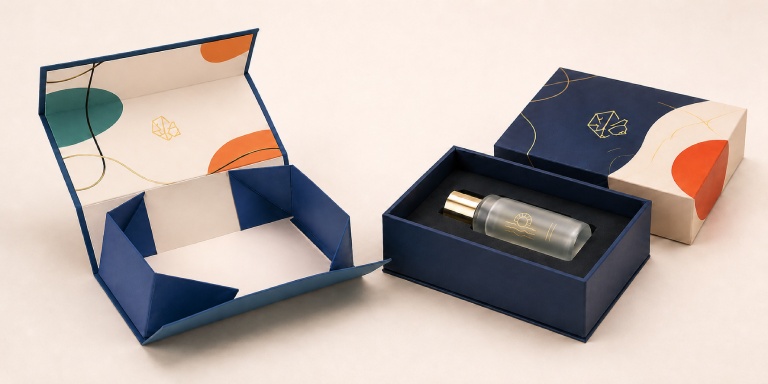
Custom rigid boxes are chosen to convey care before the product is opened. Their sturdy construction, precise edges, wrapped surfaces, and controlled reveal reinforce a premium image and result in packaging that customers often retain.
Several factors influence presentation, but not all contribute equally. Oversized boxes, overly complex structures, or excessive decoration can raise costs without enhancing perceived value.
If you have already reviewed the available constructions in our custom rigid boxes guide, the next step is to refine the specification. Our guide to custom packaging costs explains the broader pricing factors across packaging formats; this article focuses specifically on rigid boxes. The goal is not to make the box look cheaper. It is to concentrate the budget on the features customers notice and remove costs that add little to the experience.
What Affects the Cost of Custom Rigid Boxes?
A rigid box quote includes the board, wrapped paper, printing, finishes, closure components, inserts, assembly, packing, and freight. Dimensions and quantity influence nearly all of them. Consider both the production price and the total cost of getting the boxes ready for use: a collapsible design may be more involved to produce but require less freight and storage space, while an effective insert may reduce packing time and product damage.
|
Cost factor |
How to control the cost |
What to maintain |
|---|---|---|
|
Box size |
Design closely around the product |
Easy packing and a balanced presentation |
|
Construction |
Choose the simplest suitable structure |
Strength, accurate fit, and reliable closure |
|
Wrap |
Use a quality standard paper when appropriate |
Consistent colour and clean wrapping |
|
Finishes |
Apply one premium effect selectively |
A strong visual or tactile focal point |
|
Packaging Insert |
Select material based on protection needs |
Secure placement and an organized reveal |
|
Order quantity |
Test the design before ordering in volume |
Approved dimensions, fit, and artwork |
|
Shipping and storage |
Compare assembled and collapsible options |
Protection and manageable fulfillment |
How Box Size and Dimensions Affect Rigid Box Cost
Box dimensions have a major effect on cost because they influence material use, inserts, storage, and freight. A well-fitted box also creates a more intentional presentation than one with excessive empty space.
Begin with the actual product rather than a stock size or estimated dimensions. Include caps, pumps, cords, accessories, and any primary packaging that will be present in the final set. Then establish how the customer should encounter the product: in a single layer, stacked, or arranged as a collection.
The box should provide enough clearance for easy packing and removal, but not so much that the insert becomes unnecessarily large. Our guide to measuring products for custom packaging explains which dimensions to provide when developing a custom fit. Fragile items still need appropriate separation and cushioning, and the closure needs room to function. The target is a compact, deliberate layout, not a cramped one.
Compare Rigid Box Styles by Total Cost
Every structural feature should serve a clear purpose. A two-piece rigid box uses a straightforward lid-and-base construction to create a substantial presentation and classic lift-off reveal. It works well for apparel, cosmetics, confectionery, accessories, and gift sets.
Book-style and magnetic-closure rigid boxes provide a hinged opening and secure closure, making them suitable when the unboxing experience, product containment, or box reuse matters. Otherwise, a two-piece structure may leave more of the budget available for higher-quality printing, finishes, or inserts.
Collapsible rigid boxes ship and store flat, and are worth considering for large boxes, higher quantities, imported packaging, or limited warehouse space. Consider production, freight, storage, and assembly costs, not unit price alone, when comparing them with preassembled rigid boxes.
Ask for quotes on the two most suitable structures, then compare production, freight, storage, and packing together rather than relying on unit price alone.
|
Box style |
Typical total-cost position |
Best suited to |
Main cost consideration |
|---|---|---|---|
|
Two-piece |
Moderate |
Apparel, cosmetics, confectionery, and gift sets |
Simple construction, but ships and stores assembled |
|
Book style |
Moderate to higher |
Products designed around the opening experience |
Hinged construction adds production and assembly costs |
|
Magnetic closure |
Higher |
Premium gifts, electronics, and reusable packaging |
Magnets, alignment, and assembly increase production costs |
|
Collapsible |
Lower to moderate |
Large boxes, higher quantities, imports, and limited storage |
More assembly may be required, but flat packing can reduce freight and storage costs |
Total cost varies by box size, order quantity, shipping distance, storage requirements, and packing labor.
Control Costs Through Wrap Materials and Finishes
Choose the Right Paper Wrap
The wrap is the surface the customer actually touches, so it carries a large share of the premium impression. Rigid boxes can be wrapped in printed coated paper, uncoated paper, textured stock, kraft, or other specialty materials. The choice affects both appearance and cost, but a premium result does not require the most expensive paper on every project.
A standard paper wrap with strong colour control, suitable lamination, and precise application can create a clean, high-end finish. Reserve specialty papers for projects where their tactile quality supports the brand, and focus interior printing on visible areas such as the underside of the lid or a message beneath the product.
Apply Premium Finishes Selectively
Premium finishes such as foil stamping, embossing, debossing, spot UV, metallic ink, and soft-touch lamination can give a rigid box a more distinctive look and feel. However, using several treatments across large areas can quickly increase setup, tooling, and production costs without necessarily creating a stronger design.
A more cost-conscious approach is to select one focal effect and apply it where customers will notice it most. A foiled logo can stand out against a matte wrap, blind embossing can introduce subtle texture without adding another colour, and spot UV can create contrast over a restrained printed design. This keeps the presentation premium while avoiding finishes that compete for attention.
If you are unsure which treatments offer the best value, send us your artwork, and we can provide a quote for the base specification, with optional finishes priced separately. This allows you to compare the cost and visual impact of each treatment before finalizing the box.
Choose a Cost-Effective Rigid Box Insert
Custom packaging inserts secure products during transit, provide spacing and protection, and enhance presentation. Costs vary based on material, cavity design, covering, printing, and assembly.
Paperboard or corrugated inserts may be suitable for many stable products and can carry printed branding. Foam, molded pulp, or more complex fitted constructions may be appropriate when weight, fragility, surface protection, or precise display is required. The right choice depends on performance, not simply appearance.
Control costs by reducing unnecessary layers, keeping cavity shapes practical, and using a single insert to hold multiple components. A changeable insert or a printed sleeve lets you use one generic box for many different products. Do not remove necessary cushioning or loosen the fit simply to lower the cost.
Reduce Unit Costs Through Quantity Planning
Rigid boxes involve setup and assembly, so the unit cost generally improves as those costs are distributed across more boxes. The largest reduction often occurs when moving from a very small run to a moderate production quantity, while savings tend to be more gradual at higher volumes. That does not mean a brand should immediately order the largest possible run. Packaging stored for too long can tie up cash, consume space, or become obsolete after a change in the product or artwork.
Approve the structure with a sample or a small initial order, then consolidate demand once the product fit and artwork have been proven. Because we set no minimum order quantity, that first run can be as small as the project actually requires rather than whatever a supplier’s floor happens to be. Very small quantities carry a higher unit cost, and we will tell you so directly, but validating a new structure on a handful of boxes beats discovering a fit problem across a full production run.
Similar products may share a single box with different inserts, sleeves, or labels, and seasonal campaigns can sometimes change a removable printed component rather than the entire structure. Plan these variations before the dieline is finalized.
Include Shipping, Storage and Fulfillment Costs
Traditional setup boxes occupy their full volume before a product is packed. Compare how many fit in a master carton, available warehouse space, and whether the packing team can assemble a collapsible alternative. For direct-to-consumer orders, also plan an appropriately sized corrugated shipper; excess clearance can increase dimensional weight, while too little may leave the rigid box vulnerable.
Approve a Rigid Box Sample Before Production
A digital proof cannot demonstrate lid fit, opening resistance, magnet alignment, wrap texture, or insert tension. Test a physical sample with the actual product, pack and unpack it as a customer would, and, where relevant, check it inside the intended shipper. Prepare artwork for the final structure, keeping important elements away from folds, wrapped edges, and closure hardware. Our packaging design preparation guide covers dielines, bleed, safe areas, and proofing.
Where to Save and What Quality to Preserve
Some details do not look dramatic on a quote, yet they determine whether the finished box feels premium.
Protect these features when refining the specification:
- Sufficient board strength for the product’s size and packed weight
- Accurate lid, base, hinge, and closure fit
- Clean corners and consistently wrapped edges
- A box insert that holds the product securely and presents it neatly
- Colour and finish approval against the intended material
- Appropriate outer packaging for products sent through parcel delivery
These are the foundations of the experience. Savings are better found in excess size, unnecessary components, hidden decoration, and competing finishes.
Reducing rigid-box cost is not about stripping away everything that makes the packaging special. It is about understanding which features create value for the customer and which merely complicate the specification.
A right-sized box, dependable construction, clean wrap, secure fit, and one memorable finish can deliver a stronger premium impression than an oversized package crowded with decorative effects. When those decisions are made together, the box becomes easier to produce, store, pack, and scale without losing the experience it was chosen to create.
Request a Custom Rigid Box Quote
To price a custom rigid box, send us your product dimensions, packed weight, quantity, preferred box style, and any finishes you are considering. Our experienced packaging experts can recommend a specification and provide a separate quote for optional features, so you can compare costs without having to guess what to remove. Design support is included at no additional cost, so we can also help refine the dieline or artwork for the selected structure.
Custom Rigid Box Cost FAQs
Which rigid box style is generally the most economical?
Two-piece and collapsible rigid boxes can both be economical, but for different reasons. Two-piece boxes have simpler construction, which can reduce production costs, while collapsible boxes ship and store flat, potentially lowering freight and warehouse costs. The better value depends on box size, quantity, shipping distance, storage requirements, and assembly labor, so compare their total costs using the same product specification.
Will making a rigid box smaller reduce its cost?
Usually, yes. A smaller, properly fitted box uses less material and often improves packing and shipping efficiency. It must still provide enough space for the insert, closure, easy product removal, and any required protection.
How can a rigid box look premium on a controlled budget?
Prioritize accurate fit, clean construction, consistent colour, and a considered opening experience. Simplify the structure and finish count, then retain one visual or tactile feature that reinforces the brand.
What is the minimum order for custom rigid boxes?
There is no minimum. We produce rigid boxes in whatever quantity the project requires, including short validation runs of a few dozen boxes before a full production order. The unit cost is higher at low quantities because setup is spread across fewer boxes, but it is usually cheaper than committing to a large run before the fit and artwork are proven.
Professional Design & Printing Services
Printingblue offers customized commercial printing solutions to meet your business needs. Our expert team delivers top-notch design and printing services that exceed expectations. Contact us today for a free consultation.